
Baltimore City Genealogy Records
Baltimore is an independent city with its own separate court system, health department, and archives, which makes its genealogy records distinct from those of surrounding Baltimore County. This guide covers the main sources for birth, death, marriage, land, and probate records in Baltimore City and explains how to access each one.
Baltimore City Overview
Baltimore City Archives
The Baltimore City Archives at 2615 Mathews Street is the primary keeper of local government records and is an essential stop for genealogy research in the city. The archives holds the WPA Historical Records Survey Name Index from the 1930s, which indexed every name in specific record groups. Those index cards are available online in alphabetical segments and can help researchers find names across a wide range of record types quickly.
The archives holds vital records, coroner's inquests, and early city records going back to the 1800s. The coroner's inquest files from 1827 and 1835 to 1867 document suspicious deaths and can contain names, dates, and cause of death not found in standard vital records. Church records and cemetery records are also part of the archives' holdings, with locations and records for churches active before 1900. Research at the Baltimore City Archives is done by appointment.
The Baltimore City Archives holds the WPA name index, vital records, coroner's inquests, and other city records going back to the early 1800s.
Birth and Death Records in Baltimore City
Baltimore City vital records are split between the Maryland State Archives and the Maryland Department of Health. The MSA holds Baltimore birth records from 1875 to 1921 and death records from 1875 to 2011. The Department of Health handles records after those cutoff dates.
Multiple indexes exist for Baltimore City birth records at the MSA. CM1134 covers 1875 to 1941. T1344 covers 1890 to 1917 and 1950 to 1972. C2145 holds delayed birth records from 1876 to 1925. The death index at the MSA covers 1875 to 1972. FamilySearch holds Lock Funeral Home records from 1936 to 2007, which can document deaths that might be harder to trace in official records. There is no Baltimore-specific birth index for 1942 to 1949 at the MSA. For births and deaths after the cutoff dates, contact the Maryland Department of Health at 410-764-3038 or visit health.maryland.gov/vsa.
The Maryland Death Index at the MSA covers deaths statewide from 1898 to 2010 and is searchable online at msa.maryland.gov. Because Baltimore City records are indexed separately from Baltimore County records, make sure you are searching the right jurisdiction when using statewide indexes.
Marriage Records in Baltimore City
Baltimore City marriage license records start in 1851. The Maryland Genealogical Society holds an index for 1851 to 1914, though it is incomplete for 1851 to 1885. Records from 1914 to 1940 have been indexed through a FromThePage project and are accessible at the MSA. After 1951, Baltimore City marriage records are part of the state-level system. The MSA marriage index at msa.maryland.gov is a good starting point for any Baltimore City marriage search.
The Reclaim The Records collection at archive.org includes a Baltimore City naturalization index covering 1827 to 1933, compiled from multiple courts. This collection has about 76,000 names in 76 PDFs and is free to search and download. Naturalization records can help trace immigrant ancestors who settled in Baltimore during the 19th and early 20th centuries.
Baltimore City Directories
City directories are one of the most useful tools for Baltimore City genealogy research because they can place an ancestor at a specific address in a specific year between census records. The University of Maryland Libraries has digitized Baltimore City directories from 1800 to the 1950s. These are searchable online at the UMD libraries site and list residents by name and address, often including occupation and sometimes the wife's name.
Directories are especially useful for the 19th century when census records were taken only every ten years. A person who died or moved between 1870 and 1880 can sometimes be tracked through directories that cover each year in between. The directories also list businesses and occupations, which can help confirm an ancestor's livelihood or neighborhood.
Baltimore Research Facilities
The Enoch Pratt Free Library at 400 Cathedral Street, Baltimore, has a Maryland Department with strong genealogy resources. The library provides access to Ancestry Library Edition, HeritageQuest, Fold3 for military records, and historical newspapers including the Baltimore Sun, the Baltimore Afro-American, and the Maryland Gazette. These newspaper collections are particularly valuable for tracking death notices, marriage announcements, and other family events in the 19th and early 20th centuries.
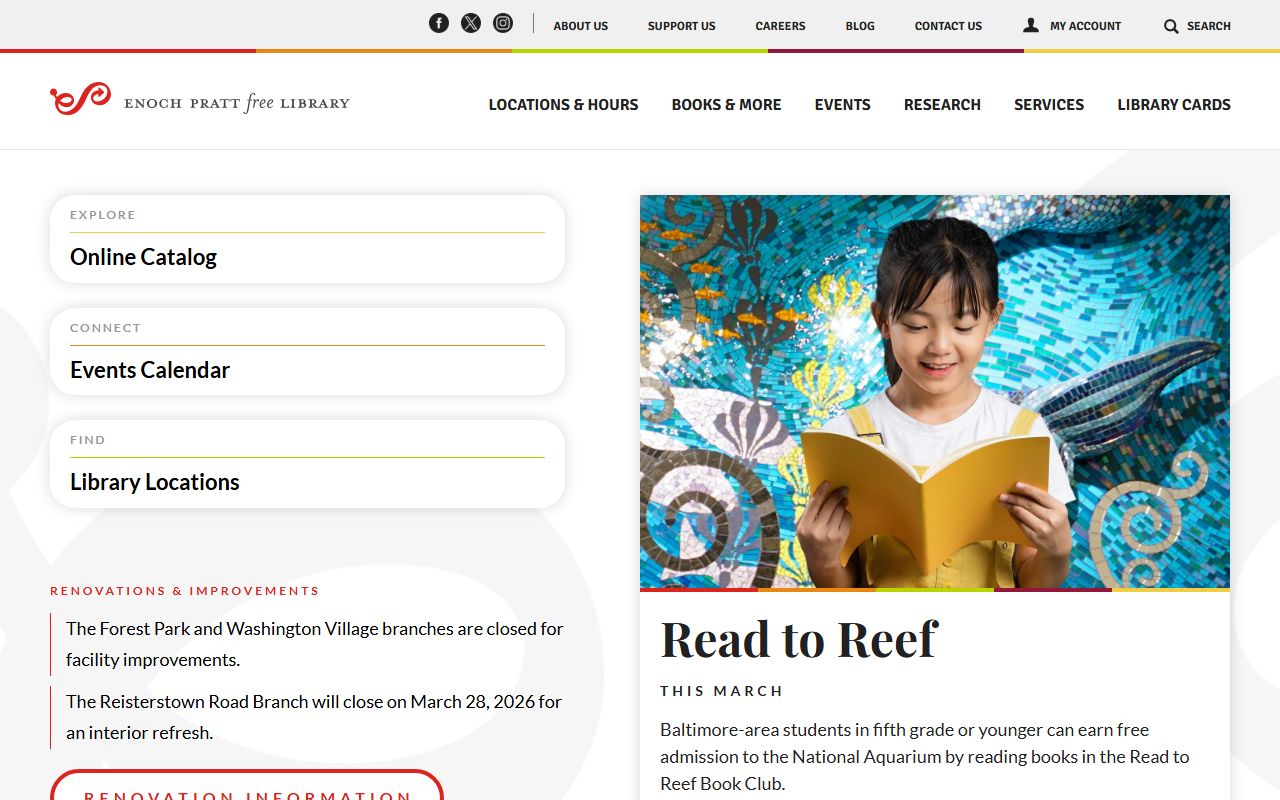
The Enoch Pratt Free Library in Baltimore provides access to major genealogy databases and digitized historical newspapers for Baltimore City research.
The Maryland Historical Society at 610 Park Avenue, Baltimore, holds extensive manuscript collections for Baltimore City and the state of Maryland. Their holdings include family papers, photographs, and unpublished genealogies specific to Baltimore families. Research at the Maryland Historical Society is done by appointment and their website at mdhistory.org lists current access details and collections.
Using the Maryland State Archives for Baltimore City Research
The Maryland State Archives at 350 Rowe Boulevard, Annapolis, holds Baltimore City records from the 19th century through the mid-20th century. Call 410-260-6400 or search online at msa.maryland.gov. The research guide at guide.msa.maryland.gov lists the most requested records by location and type. The FamilySearch wiki for Baltimore City at familysearch.org also provides a useful overview of available records and where to find them.
Under Maryland Code, General Provisions sections 4-101 and following, most public records in Maryland are open to inspection. Death records are public after 10 years. Birth records are restricted for 100 years. Marriage records are fully public. Because Baltimore City is an independent jurisdiction, its records are kept separately from Baltimore County, and researchers need to be sure they are searching the right entity when using online or in-person resources.
Nearby Cities
Baltimore City is bordered by Baltimore County, which has its own separate court system. Researchers working on Baltimore area families often need to check both Baltimore City and Baltimore County records, especially when tracing families that moved between the city and surrounding communities.